




How Soil Affects Your Home’s Foundation: 5 Common Problems to Know
When you think about your home’s foundation, you probably picture the concrete walls or slab supporting the structure. But there’s something equally important beneath it all: the soil.
The ground underneath and surrounding your home plays a major role in keeping your foundation stable. When soil shifts, settles, expands, or becomes oversaturated with water, it can place stress on the foundation and contribute to structural problems over time.
For homeowners in South Dakota, Wyoming, and Nebraska, changing seasons, fluctuating moisture levels, and freezing temperatures make understanding soil conditions especially important.
Let’s take a closer look at five common soil-related problems, how they affect your foundation, and what you can do to help protect your home.
Why Does Soil Matter to Your Foundation?
Your home’s foundation is designed to transfer the weight of the structure to the soil beneath it. For that system to work properly, the ground must provide adequate, consistent support.
However, not all soils behave the same way. Some retain moisture and expand, while others drain more readily. Certain soils may compress under pressure, and others can lose stability when exposed to excessive water.
The real concern often arises when soil conditions change unevenly around or beneath a home. One section of the foundation may settle or move while another remains relatively stable. This is called differential movement, and it can cause cracks, uneven floors, and other signs of structural stress.
Understanding what causes these changes is an important step toward preventing or addressing foundation problems.
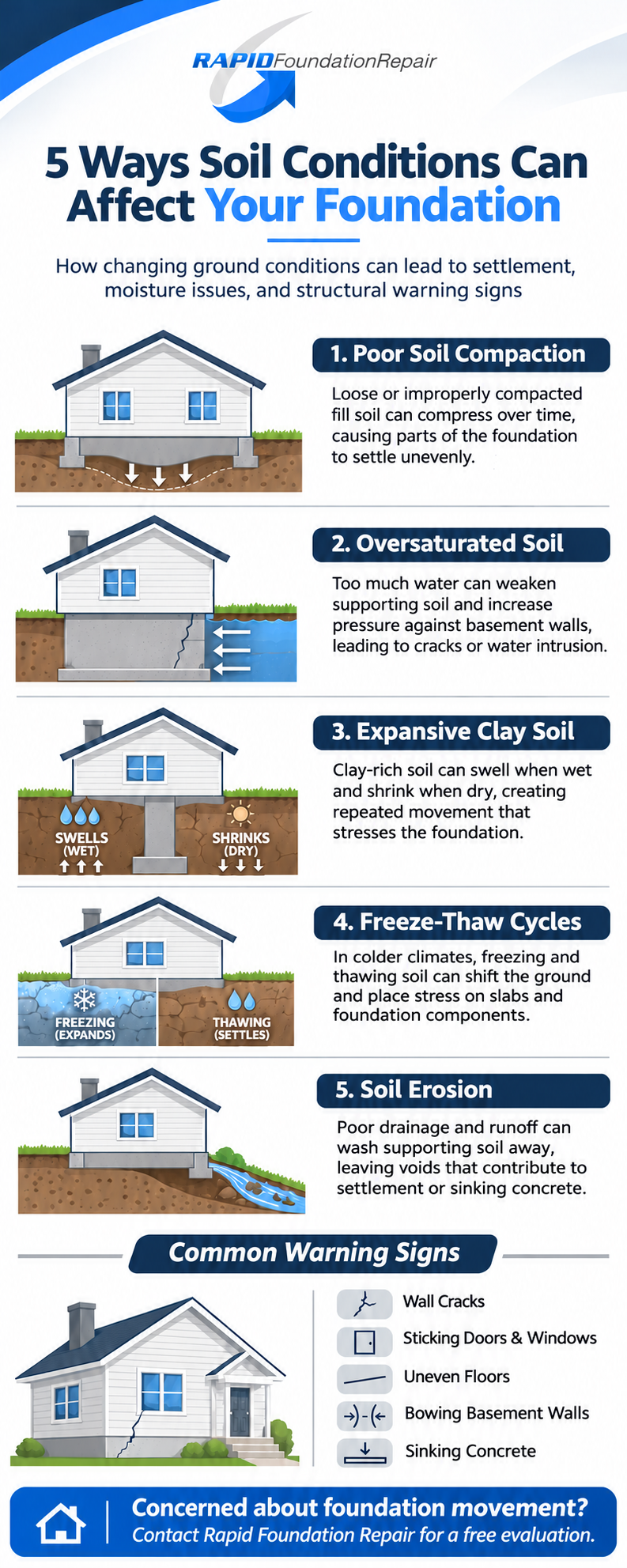
1. Poor Soil Compaction Can Lead to Foundation Settlement
Before construction begins, the soil beneath a foundation must be capable of supporting the structure’s weight. When fill soil isn’t properly compacted during construction, it may gradually compress under the weight of the home.
As that soil compresses, the foundation can settle. If the movement occurs unevenly, portions of the structure may begin to shift out of alignment.
Poorly compacted fill can also settle around a home’s exterior, changing the way surface water drains and allowing water to collect near foundation walls.
Signs of possible foundation settlement include cracks in interior walls, gaps around windows, sticking doors, or floors that appear to slope.
It’s important to remember that some minor settlement can occur as a home ages. However, noticeable or continuing movement deserves closer attention.
2. Oversaturated Soil Can Weaken Foundation Support
Water is one of the biggest influences on soil stability.
When soil becomes excessively saturated, certain soil types can lose strength and become less capable of supporting a structure. Excess moisture can also contribute to erosion, soil movement, and drainage problems.
Water may accumulate around a foundation because of heavy rainfall, melting snow, poor grading, clogged gutters, or downspouts that discharge too close to the house.
For homes with basements, saturated soil can also increase hydrostatic pressure, which is the pressure groundwater exerts against foundation walls. Depending on the conditions, that pressure can contribute to water intrusion, cracking, or inward wall movement.
Proper drainage is an important part of managing these risks. Directing water away from the home helps reduce unnecessary moisture buildup around the foundation.
If you’re noticing persistent basement moisture or water entering your home, learn more about Rapid Foundation Repair’s water seepage solutions.
3. Expansive Clay Soil Can Shrink and Swell
Some soils contain clay minerals that change volume as their moisture content changes. These are known as expansive soils.
When expansive clay absorbs moisture, it can swell and exert pressure against nearby structures. During prolonged dry periods, that same soil may shrink, potentially reducing support beneath portions of a foundation.
Repeated cycles of expansion and contraction can contribute to uneven foundation movement, particularly when moisture levels vary around the home.
Depending on the soil conditions and foundation design, expansive soil movement may lead to cracked foundation walls, shifting concrete slabs, or changes in the alignment of doors and windows.
Not every property has expansive soil, and not every crack is caused by soil movement. Understanding the soil conditions at a particular home is essential when determining the cause of a foundation problem.
4. Freeze-Thaw Cycles Can Contribute to Ground Movement
Winter weather creates another challenge for foundations throughout South Dakota, Wyoming, and Nebraska.
When moisture in frost-susceptible soil freezes, ice can accumulate within the ground and cause it to expand upward. This process, known as frost heave, can place stress on concrete slabs, sidewalks, and certain shallow foundation components.
As temperatures rise and frozen ground begins to thaw, soil conditions can change again. Snowmelt may also increase moisture levels around a home, particularly where drainage is inadequate.
The effects depend on several factors, including soil type, moisture content, frost depth, and foundation construction.
Maintaining proper drainage and addressing standing water around the home can help reduce some of the moisture-related conditions that contribute to seasonal soil movement.
5. Soil Erosion Can Reduce Foundation Support
Soil erosion occurs when water gradually carries soil particles away from an area.
Around a home, erosion can develop where runoff repeatedly follows the same path, especially near downspouts, poorly graded landscaping, or drainage channels.
Over time, erosion may remove supporting soil around concrete slabs, walkways, or other foundation-related structures.
In some cases, homeowners may notice washed-out areas, gaps beneath concrete, or sinking pavement near the house.
Because erosion often begins as a drainage problem, identifying and correcting the source of the water is just as important as addressing any resulting structural movement.
Warning Signs That Soil Movement May Be Affecting Your Foundation
Soil-related foundation problems aren’t always immediately visible. In many cases, homeowners first notice changes inside or around the house.
Some common warning signs include:
- Cracks in foundation walls or brickwork, especially those that grow or change over time.
- Doors and windows that stick, which can occur when structural movement affects their alignment.
- Uneven or sloping floors that develop or become more noticeable.
- Gaps around windows, doors, or trim that may indicate movement within the structure.
- Bowing or leaning basement walls, which can be associated with pressure from surrounding soil.
- Sinking or uneven concrete around garages, driveways, sidewalks, or other areas.
Not every crack or uneven surface means you have a serious foundation problem. However, multiple symptoms, worsening conditions, or noticeable structural movement should be evaluated.
For a closer look at which cracks deserve attention, read our guide to cracks in your home.
How Can You Help Protect Your Foundation From Soil-Related Problems?
You can’t control the weather or completely prevent natural soil movement, but there are practical steps you can take to reduce avoidable moisture-related problems.
Start by checking your gutters and downspouts. Make sure they’re functioning properly and directing water away from the house rather than allowing it to collect near the foundation.
Pay attention to the slope of the ground around your home. Low spots and areas that direct water toward the structure may need drainage improvements.
It’s also a good idea to inspect your basement, crawl space, and exterior foundation periodically, particularly after heavy rainfall or seasonal thawing.
If you notice new cracks, document their locations and watch for changes. Growing cracks, significant wall movement, or several warning signs appearing together are good reasons to schedule a professional evaluation.
What Happens When Soil Movement Causes Foundation Damage?
The appropriate repair depends on what’s causing the movement and how the structure has been affected.
For example, when a foundation is settling because the soil beneath it can no longer provide adequate support, a structural piering system may be recommended.
Steel push piers and helical piers are two solutions Rapid Foundation Repair offers for certain settlement problems. These systems transfer structural loads to deeper, more stable supporting soil or rock, depending on the design and site conditions.
When excessive water or soil pressure is the primary concern, appropriate repairs may instead involve drainage improvements, waterproofing, or foundation wall reinforcement.
Because soil conditions and foundation problems vary from one property to another, an accurate diagnosis is important before selecting a repair method.
Frequently Asked Questions About Soil and Foundation Problems
Can soil movement damage a foundation even if the house is relatively new?
Yes. Foundation problems can develop in newer homes when soil conditions, drainage, or construction-related factors affect stability. However, minor cosmetic cracking doesn’t automatically indicate structural damage.
Is clay soil bad for a foundation?
Not necessarily. Some clay soils have significant shrink-swell potential, while others are more stable. The type of clay, moisture conditions, and foundation design all influence the risk of movement.
Can poor drainage cause foundation settlement?
Poor drainage can contribute to conditions associated with foundation movement. Persistent water accumulation may weaken certain soils, increase pressure against basement walls, or contribute to erosion. The specific effects depend on the property.
Can soil-related foundation problems be repaired?
Many soil-related foundation problems can be addressed with appropriate structural repairs, drainage improvements, or a combination of solutions. The first step is determining what’s causing the problem.
Concerned About the Soil Beneath Your Home? Rapid Foundation Repair Can Help.
Your home’s foundation depends on stable support from the ground beneath it. While changing soil conditions are a natural part of the environment, understanding their effects can help you recognize potential problems before they become more serious.
If you’ve noticed foundation cracks, settling, uneven floors, or other signs of structural movement, the experienced team at Rapid Foundation Repair can help identify the cause and recommend an appropriate solution.
We provide foundation repair services throughout South Dakota and portions of Wyoming and Nebraska.
Concerned about your home’s foundation? Contact Rapid Foundation Repair today to schedule a free foundation evaluation.