




Home > Foundation Repair > Steel Push Piers
Steel Push Piers for South Dakota, Wyoming, and Nebraska
Steel push piers are a proven way to stop a settling foundation and, in many cases, lift it back toward its original position. Rapid Foundation Repair installs push piers for homes and other structures across South Dakota, Wyoming, and Nebraska. Every pier is driven to stable soil or bedrock and load tested before we lift anything.
What Are Push Piers?
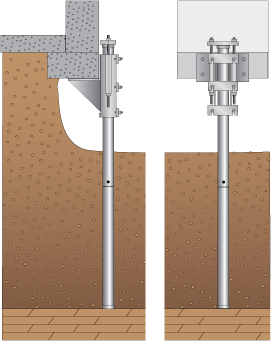 Push piers, also called resistance piers, are galvanized steel pipes driven deep into the ground beneath a foundation. A steel bracket attaches each pier to the footing. Once the piers reach soil or rock strong enough to carry the building, they transfer the structure’s weight off the weak, shifting soil near the surface and onto that stable layer.
At Rapid Foundation Repair, we use products manufactured in the USA by Earth Contact Products.
How Push Piers Work
Push piers use the weight of your home as the driving force. A hydraulic cylinder pushes each pier section down through the soil, and the building’s own weight provides the resistance. When a pier stops advancing at a measured force, it has reached a layer that can support the load. That is why push piers give you real data about your foundation instead of a guess.
Because installation is driven by load, push piers work best on heavier structures such as full-size homes and buildings with substantial foundation walls.
Signs Your Foundation May Need Push Piers
Settlement often shows up gradually. Common warning signs include:
- Stair-step cracks in brick, block, or stone
- Cracks in drywall running from the corners of doors and windows
- Doors and windows that stick or no longer latch
- Gaps between walls and the ceiling, floor, or trim
- Sloping or uneven floors
- A chimney or porch pulling away from the house
- Cracks in the foundation wall that are widening over time
Cracks alone don’t always mean a structural problem, so we inspect before recommending a fix. Causes we commonly see include poorly compacted fill soil, moisture changes in clay soils, and drainage problems near the foundation.
Benefits of Steel Push Piers
- Verified support – Each pier is load tested to a force greater than the working load it will carry, so the support is measured rather than assumed.
- Fast, low-disruption installation – The equipment is hydraulic, relatively quiet, and portable enough to work in tight spaces, including from inside a structure when needed.
- No curing time – Once the piers are installed and tested, the structure can be lifted right away. There’s no waiting for concrete to cure.
- Lift and stabilization – Piers stop further settlement, and the foundation can often be lifted back toward its original elevation or to the level recommended by an engineer.
- Durable steel – ECP push piers are manufactured with American-made steel and meet strict quality standards and regulations.
Our Push Pier Installation Process
1. Site survey and utility check
We locate pier positions around the structure and verify where underground utilities run.
2. Excavation
We dig small access holes, or in some cases along the full perimeter, at each pier location. Each area is typically about 3 feet square at the foundation.
3. Foundation preparation
We notch the footing to seat the bracket under the stem wall, smooth and level the bearing area, and make the wall face vertical where the bracket attaches.
4. Bracket attachment
The steel bracket is secured to the footing with anchor bolts, and the drive stand and hydraulic cylinder are mounted.
5. Driving the piers
A hydraulic pump and cylinder push each pier into the ground, using the structure as reaction force. Piers can be installed from outside or inside the structure. We continue until we reach rock or a suitable bearing layer below the unstable soil.
6. Load testing
Every pier is tested to confirm the bearing layer can hold more than the load it needs to carry. An engineer typically sets the structure’s load and the desired factor of safety before testing begins.
7. Preparing for lift
Once all piers are installed, tested, and their data recorded, we place lifting heads and hydraulic rams on the piers and connect them so they lift together.
8. Lifting and stabilizing
Under careful supervision, the load transfers from the failing soil to the tested piers. The structure is lifted gently and evenly toward its original elevation, or to the engineer’s recommendation. We then secure the nuts at each pier cap and remove the lifting equipment.
9. Backfill and clean-up
We replace and compact the excavated soil and leave the site clean and neat.
Push Piers vs. Helical Piers
Both are steel deep foundation solutions, but they’re installed differently and suit different jobs.
| Push Piers | Helical Piers | |
|---|---|---|
| Installation | Pushed hydraulically, using the structure’s weight | Screwed into the ground with torque |
| Best for | Heavier structures | Lighter structures, or where weight is limited |
| Verification | Load tested during installation | Torque used to estimate capacity |
| Commonly used for | Home foundation settlement | Porches, decks, additions, lighter loads |
Which one fits depends on your soil, the weight of the structure, and how far down stable strata lie. We’ll recommend the right solution after inspecting the property.
Are Push Piers Right for Your Foundation?
Push piers are a strong fit for many settling homes, but not every foundation problem calls for them. Some issues are better handled with helical piers, slab piers, drainage correction, or other repairs. Our estimators look at the cause of the movement first, then recommend a solution that fits your structure, whether it’s a home or a garage.
Push Pier Cost
Push pier cost depends on the number of piers needed, how deep stable soil is, access to the foundation, and whether the structure needs to be lifted. We provide free estimates so you know the scope and price before any work begins.
Get a Free Push Pier Estimate
Each foundation problem is different. If you’re seeing cracks, sticking doors, or uneven floors, we can help you determine whether push piers are the right repair. Call Rapid Foundation Repair or request a free estimate in South Dakota, Wyoming, and Nebraska.